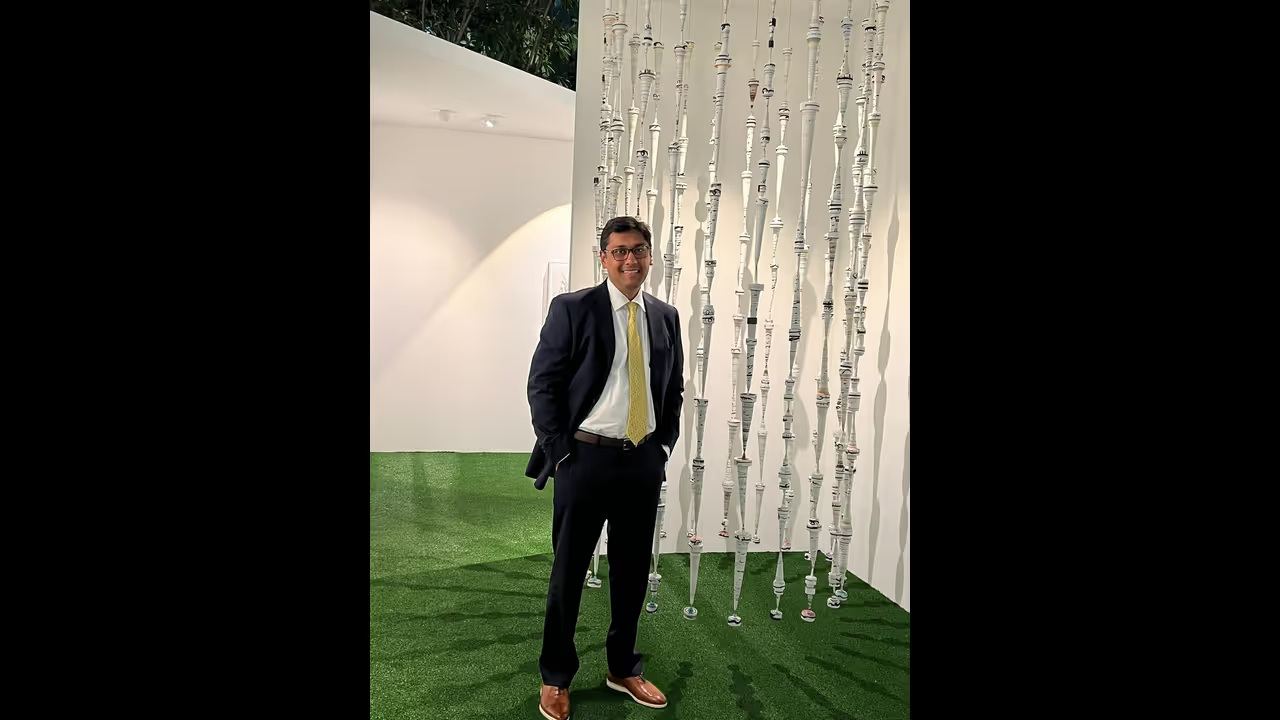
Growing up in a business family, Maloo observed firsthand how enterprise was not merely about expansion, but about stewardship.
For Vaibhav Maloo, business and belief are not parallel tracks — they are deeply interconnected. As Managing Director of Enso Group and Chairman of Enso Webworks, his leadership philosophy reflects a blend of capital discipline and spiritual grounding, shaped significantly by Jain principles and lessons inherited from his father, Vinay Maloo.
At the core of this worldview lies a simple but powerful idea: wealth creation carries responsibility.
Growing up in a business family, Maloo observed firsthand how enterprise was not merely about expansion, but about stewardship. From his father, he learned that credibility compounds faster than capital, and that long-term respect in business is built through ethical conduct, measured risk and social contribution.
Related Articles

Jain philosophy, particularly the principles of ahimsa (non-violence), aparigraha (non-possessiveness) and accountability for one’s actions, has influenced his approach to leadership. In a corporate context, these values translate into sustainable growth, restraint in decision-making and conscious capital allocation.
For Maloo, giving back is not episodic charity; it is structural intent. The philosophy is embedded in how businesses are designed creating employment, investing in digital infrastructure, and building systems that enable others to grow. Rather than separating profit from purpose, he views both as part of the same cycle.
This perspective also informs Enso’s broader initiatives, where the emphasis is on building scalable frameworks that generate measurable impact. The idea is not to donate after value is created, but to design value creation itself in a way that benefits stakeholders beyond shareholders.
In blending Jain ethics with modern enterprise strategy, Maloo represents a model of leadership where karma and capital coexist. The lesson passed down from Vinay Maloo continues to shape this approach: true legacy is not defined by accumulation, but by contribution.
In an era where business influence is global and digital, this philosophy of giving back positions Indian enterprise not just as an economic force, but as a responsible one.