
A Sole Proprietorship is the simplest and most common form of business structure for individual entrepreneurs in India.
Embarking on a solo entrepreneurial journey in India presents an exciting array of opportunities. As a single founder, one of the most fundamental decisions you'll make is choosing the legal structure for your business. This choice significantly impacts your liability, compliance burden, credibility, and future growth potential.
In India, two popular options for single-owner businesses are Sole Proprietorship Registration and One Person Company (OPC) Registration. While both allow a single individual to own and operate a business, their legal frameworks and implications are vastly different. Understanding these distinctions is crucial for setting your venture on the right path.
Sole Proprietorship: The Simplest Path to Business Ownership
Related Articles

A Sole Proprietorship is the simplest and most common form of business structure for individual entrepreneurs in India. It's not a separate legal entity from its owner; essentially, the individual and the business are considered one and the same in the eyes of the law.
Key Characteristics & Advantages of Sole Proprietorship Registration:
Ease of Formation: This is its biggest draw. Sole Proprietorship Registration is incredibly straightforward, often requiring minimal paperwork and no formal registration with a central authority like the Ministry of Corporate Affairs (MCA). You can effectively start operating by simply obtaining basic business licenses (like a Shop & Establishment license) or tax registrations (like GST, if applicable).
Low Cost: The cost to set up and maintain a sole proprietorship is significantly lower compared to an OPC.
Full Control: As the sole owner, you have complete control over all business decisions. There are no shareholders or a board to consult.
Minimal Compliance: The ongoing compliance burden is very light. Primarily, it involves filing your personal income tax returns (ITR) with business income and GST returns if registered.
Direct Profit Ownership: You, as the proprietor, directly own all the profits generated by the business.
Disadvantages of Sole Proprietorship:
Unlimited Liability: This is the most significant drawback. There's no legal distinction between you and your business. If the business incurs debts or legal obligations, your personal assets (house, car, savings) can be used to settle them.
Limited Credibility: Without a separate legal identity, a sole proprietorship may be perceived as less formal or credible by potential clients, investors, or large corporate entities.
Difficulty in Raising Funds: Access to external funding (from banks or investors) can be challenging as the business entity lacks a distinct legal identity and asset base.
No Perpetual Succession: The business's existence is tied directly to the proprietor. If the proprietor passes away or becomes incapacitated, the business may cease to exist.
One Person Company (OPC): The Best of Both Worlds?
Introduced in the Companies Act, 2013, the One Person Company (OPC) Registration offers a unique hybrid structure. It allows a single individual to operate a company with the advantages of limited liability, typically associated with private limited companies. An OPC is a distinct legal entity separate from its owner.
Key Characteristics & Advantages of One Person Company (OPC) Registration:
Limited Liability Protection: This is the primary benefit. The owner's personal assets are protected from the company's debts and liabilities. Your liability is limited to the capital you've invested in the business.
Separate Legal Entity: The OPC has its own legal identity, separate from its owner. It can own property, enter into contracts, and sue or be sued in its own name. This enhances its credibility and professional image.
Perpetual Succession: Unlike a sole proprietorship, an OPC continues to exist even if the sole member passes away or becomes incapacitated, as a nominee director is appointed at the time of incorporation.
Enhanced Credibility and Funding Access: Being a registered company under the Companies Act, an OPC generally enjoys higher credibility among banks, investors, and vendors. This can make it easier to secure loans or attract investments compared to a proprietorship.
Conversion Flexibility: An OPC can be easily converted into a Private Limited Company as the business scales and adds more members or directors.
MSME Benefits: OPCs are often eligible for various benefits and schemes offered to Micro, Small, and Medium Enterprises (MSMEs) by the government.
Disadvantages of One Person Company (OPC):
Higher Compliance Burden: While less stringent than a Private Limited Company, One Person Company (OPC) Registration involves more ongoing compliance than a sole proprietorship. This includes mandatory annual filings with the MCA (Registrar of Companies), statutory audits, and board meetings (even if just a single director passing resolutions).
Higher Setup and Maintenance Costs: The incorporation process for an OPC is more complex and costly than setting up a proprietorship.
Nominee Requirement: You must appoint a nominee who will take over the company in case of the original owner's death or incapacity.
Restrictions: An OPC cannot undertake non-banking financial investment activities, and its turnover must not exceed a certain limit for a continuous period, beyond which it must convert to a Private Limited Company.
Making the Right Choice: Sole Proprietorship vs. OPC
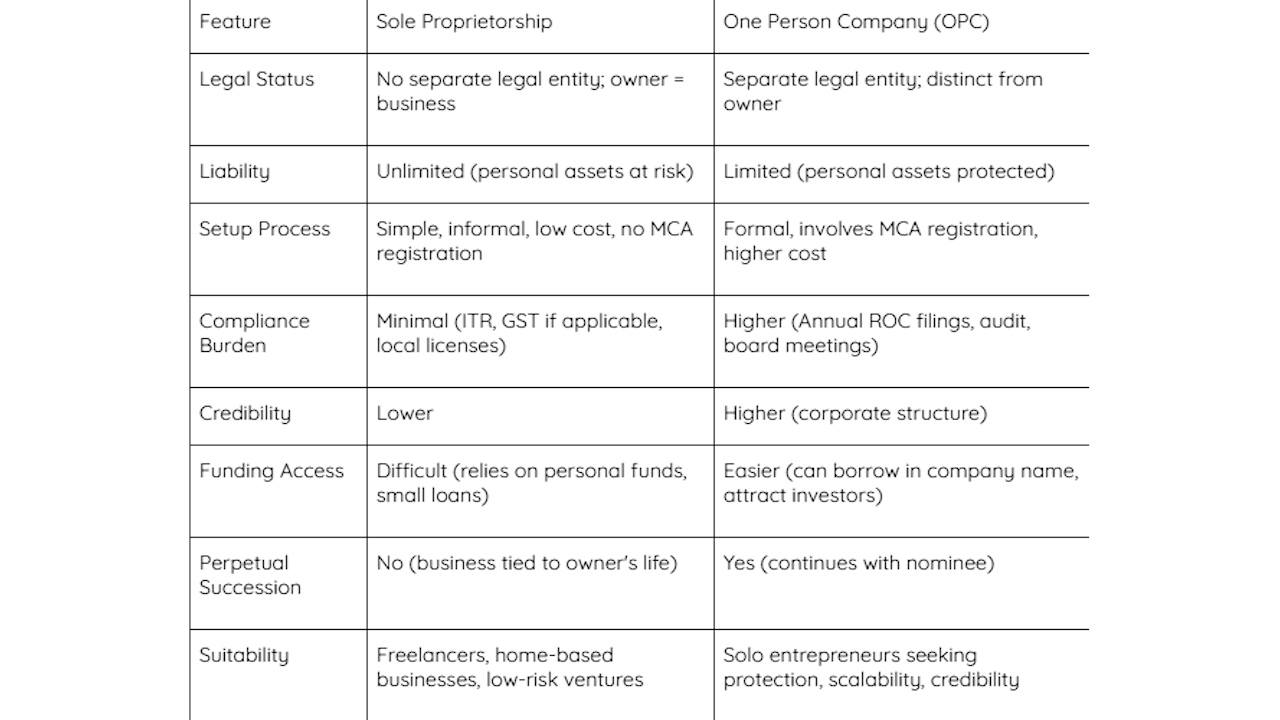
When to choose Sole Proprietorship Registration:
You're just testing a business idea with minimal capital and low risk.
You want the absolute simplest setup and lowest compliance costs.
Your personal assets are not substantial or you're comfortable with unlimited liability.
When to choose One Person Company (OPC) Registration:
You want to protect your personal assets from business liabilities.
You aim for higher credibility for your brand, especially when dealing with larger clients or seeking funding.
You envision scaling your business in the future and want a more formal structure.
You need perpetual succession for your business.
The decision between Sole Proprietorship Registration and One Person Company (OPC) Registration is a critical one that impacts your business's legal standing, financial risk, and growth trajectory. While the simplicity of a proprietorship is appealing for initial ventures, an OPC offers significant advantages in terms of liability protection and credibility for those looking to build a more robust and scalable enterprise.
To make an informed decision tailored to your specific business goals and to navigate the registration processes seamlessly, it is highly advisable to seek expert guidance. Professionals at RegisterKaro can provide detailed insights into the nuances of Sole Proprietorship Registration and One Person Company (OPC) Registration, ensuring you choose the right structure and comply with all legal requirements from day one.