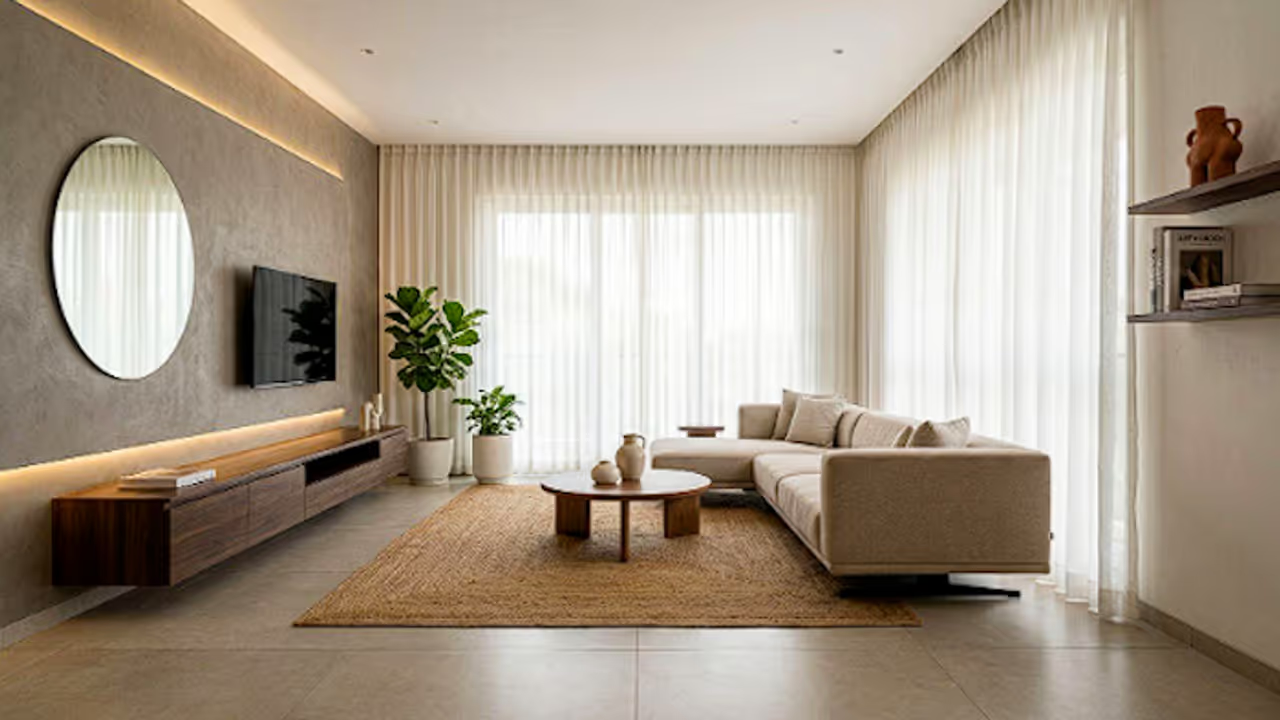
Interior planning in India is rarely treated as a structured, standalone phase. Quotations are often broad. Bills of quantities lack detailed breakdowns. Vendor comparisons are informal. Pricing transparency varies widely across cities.
India’s home interiors industry has long operated on a familiar script. A homeowner approaches a designer or contractor with a vision. Initial conversations feel promising. Estimates are shared. Work begins. And somewhere along the way, clarity starts to fade.
Budgets expand. Specifications shift. Scope becomes flexible. By the time concerns arise, homeowners are already committed — financially and emotionally.
It is a pattern so common that many have come to accept it as inevitable.

A Hyderabad-based platform, Houspire, is questioning that assumption — not by offering better execution, but by stepping away from execution entirely.
The Real Problem Isn’t Design. It’s Planning.
Industry observers often focus on execution delays or contractor disputes. But according to Houspire’s founders, the deeper issue lies earlier — in the planning stage.
Interior planning in India is rarely treated as a structured, standalone phase. Quotations are often broad. Bills of quantities lack detailed breakdowns. Vendor comparisons are informal. Pricing transparency varies widely across cities.
In most cases, homeowners are asked to finalise decisions without having full visibility into materials, scope definitions, or cost benchmarks.
Planning, arguably the most financially sensitive stage of the project, remains the least standardised.
A Separation the Market Hasn’t Seen Before
Houspire’s model is built on a simple but uncommon premise: planning and execution should not be tied together.
The platform does not execute projects. It does not sign contractors. It does not earn referral commissions. It does not operate as a marketplace.
Instead, it positions itself as an independent planning layer — one that homeowners engage before selecting a vendor.
For a fixed fee of ₹4,999, the platform provides:
- Realistic 3D interior renders aligned to the homeowner’s layout
- A detailed and itemised Bill of Quantities
- Locked pricing estimates
- Structured, city-specific vendor recommendations
All deliverables are provided within 72 hours, before homeowners commit to any execution partner.
The idea is to ensure that key financial and design decisions are defined upfront — rather than negotiated mid-project.
Why This Model Matters
India’s interior industry is estimated to be worth billions, yet remains largely unregulated and relationship-driven. Much of the decision-making still depends on trust and sales narratives rather than verifiable comparisons.
By separating planning from execution, Houspire alters the incentive structure.
Because it does not earn from vendor margins or execution contracts, its recommendations are not tied to downstream revenue. This independence, the founders argue, allows homeowners to assess vendors based on scope clarity, pricing logic, and comparability rather than persuasion.
The shift may appear subtle, but structurally, it rebalances power.
Homeowners approach execution discussions with defined scope and cost visibility. Vendors engage with clearer expectations. Negotiations become more transparent.
The Founders’ Perspective
Houspire is led by Abhishek Khanna, a business strategist with experience in scaling design-led ventures, and Saloni Narayankar, an award-winning interior designer and founder of SNI with over a decade of experience in luxury residential projects.
Their combined background reflects both operational and creative insight. According to those familiar with the platform’s development, the idea emerged from repeated observations of planning-stage ambiguity across projects of varying budgets.
Rather than attempting to compete with design firms, they chose to intervene earlier in the process — where most uncertainty originates.
A Potential Category Shift
Houspire does not describe itself as a design company or a contractor network. It operates closer to a pre-execution advisory layer — a segment that has not yet been formally defined in India’s interior ecosystem.
If the model gains traction, it could introduce a new norm: planning as an independent, accountable service.
In an industry where aesthetic outcomes often dominate conversations, Houspire’s bet is different.
Before style comes structure.
Before execution comes clarity.
And for a growing number of Indian homeowners, that may be the more disruptive idea.