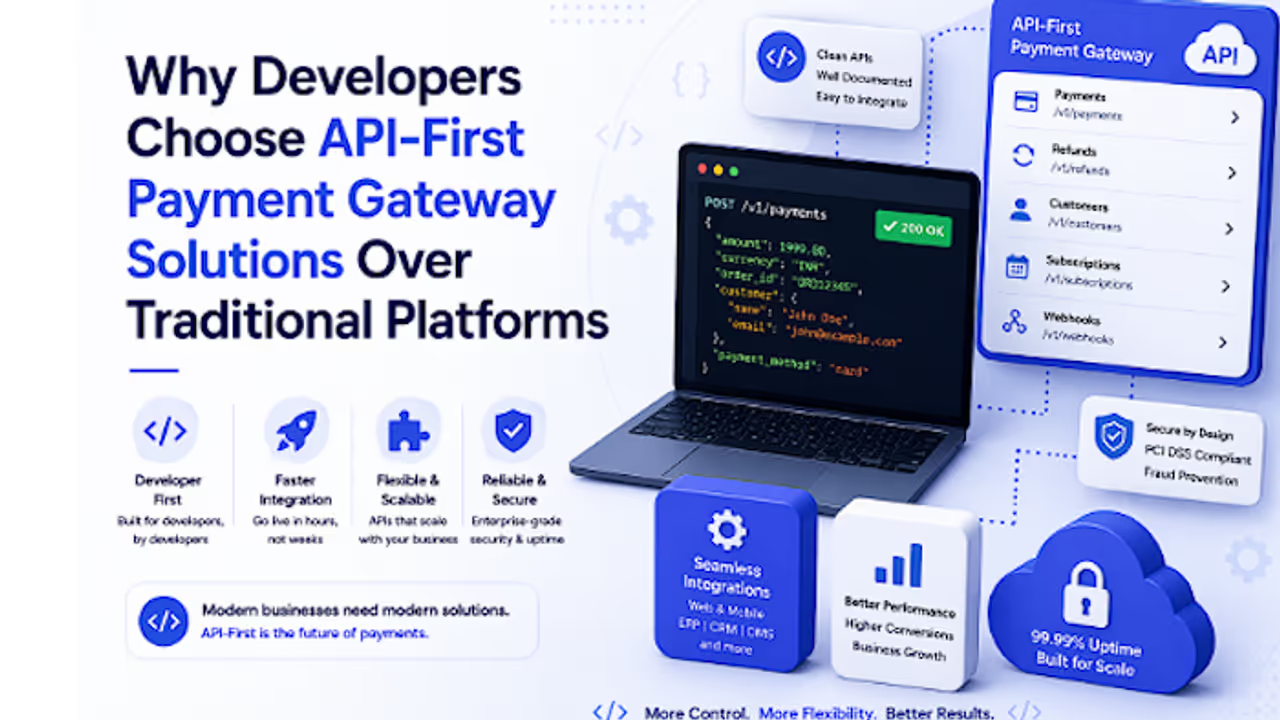
This article explores why modern development teams are shifting toward payment integration API solutions.
Traditional payment platforms lock developers into rigid integration paths, but a payment gateway API changes that paradigm entirely. API-first solutions give developers complete control over payment flows, faster implementation timelines, and the flexibility to build custom checkout experiences without platform constraints.
This article explores why modern development teams are shifting toward payment integration API solutions. We'll examine architectural differences, developer experience improvements, and scalability benefits. In particular, we'll look at how a developer-friendly payment gateway approach enables parallel development, supports multiple payment methods, and future-proofs your payment infrastructure. Solutions like Cashfree Payment Gateway demonstrate these API-first advantages in action.
Understanding API-First Payment Gateway Architecture
Related Articles

What makes a payment gateway API-first
An API-first payment gateway treats APIs as the primary product rather than an afterthought wrapped around existing infrastructure. The distinction lies in the contract-first design philosophy. Traditional banks build internal systems and then expose functionality through APIs, creating leaky abstractions where old system limitations force themselves onto developers. In contrast, API-first platforms design the APIs before writing any other code, positioning them as building blocks that support the entire application.
This architecture exposes all payment capabilities through well-defined APIs, including transaction processing, settlement, reconciliation, and reporting. Each capability functions as a discrete, well-documented service that other systems can consume. The payment integration API becomes a headless service, delivering checkout, billing, and payout functionality to any platform: web dashboards, mobile apps, or automated systems.
The workflow operates on event-driven architecture and asynchronous communication. When your application sends a request, the API orchestrates several microservices. First, validation checks for an idempotency-key to prevent double-charging during network retries. Next, tokenization replaces raw card data with network tokens, ensuring main servers never see sensitive data. Risk scoring engines run AI-driven fraud assessments in milliseconds. The system then identifies the destination and routes funds through local clearing systems like ACH or SEPA rather than slow SWIFT networks. Finally, webhook execution fires server-to-server notifications telling your application to update user balances or ship products.
How traditional payment platforms process transactions
Traditional payment systems were designed for closed environments where banks controlled both infrastructure and distribution. These monolithic systems rely on batch processing, limited data payloads, and rigid architectures that make modifications time-consuming and prohibitively expensive. Payment gateways in these systems act as digital point-of-sale terminals, guiding transactions through authorization, authentication, and clearing steps.
When a customer enters card and billing data, the gateway sends transaction details to the merchant's acquiring bank, which forwards them to the customer's issuing bank. The issuing bank verifies available funds and transaction legitimacy before sending back an approval code. Authentication measures like 3D Secure verify cardholder identity. After authorization and authentication, the gateway sends final transaction details to card networks for processing, followed by settlement where funds transfer to the merchant's account.
These systems required point-to-point integrations between specific banks, clearinghouses, and payment networks. Establishing cross-border capabilities meant negotiating individual relationships with local banks in each market, navigating disparate regulatory frameworks, and building custom technical integrations for each connection. This process could take months or years, requiring massive capital expenditure before processing a single transaction. Furthermore, transactions routed through correspondent banking networks frequently suffered from unpredictable fees, delayed settlement times, and limited visibility into fund status.
Key architectural differences that impact development
The fundamental problem with monolithic payment suites centers on their architecture. When payment processing, fraud detection, reporting, and settlement live in a single codebase, changing any component risks breaking others. Vendors become cautious about updates, and enterprises become dependent on vendor timelines that rarely align with business needs.
API-first platforms solve these challenges by enabling plug-and-play integration, reducing dependency on internal systems, and allowing faster product launches. Rather than building point-to-point connections with multiple financial institutions, businesses integrate with a single platform that abstracts underlying complexity. These platforms handle legacy integrations, regulatory compliance, and network connectivity, exposing capabilities through developer-friendly payment gateway interfaces.
What previously required months of negotiation and custom development now takes days. Companies can launch sophisticated financial products up to ten times faster than traditional methods. The modular nature allows businesses to select specific financial modules they need and easily add new capabilities as requirements evolve. This flexibility enables scaling operations without constraints from rigid legacy systems, while shifting from capital expenditure to operational expenditure models that can reduce infrastructure costs significantly.
Developer Experience and Faster Integration
Complete access to payment functionality through APIs
API-first payment platform grants developers programmatic access to every payment capability through RESTful endpoints. Your engineering team triggers payouts based on business logic, whether paying drivers after deliveries or disbursing royalties to creators on schedules. This eliminates manual processing bottlenecks that plague traditional systems. You get direct control over payment rails through code, handling multiple payment methods across domestic and international networks without leaving your tech stack.
The approach delivers measurable speed advantages. Integration times drop dramatically: rapid MVPs launch in one to five days using pre-built UI components, standard implementations connect marketplaces to billing and payout APIs within weeks, while enterprise overhauls migrating complex legacy systems complete in a few months. Nearly 90% of payment system providers cite efficiency gains as a key driver for API adoption, with APIs removing manual processes that slow down payouts and reconciliation.
No waiting for feature requests or custom implementations
Traditional platforms force developers into vendor-controlled release cycles. API-first systems flip this model by exposing capabilities immediately. Modular embedded finance provides specific capabilities that integrate independently or together, rather than rigid all-in-one products. Businesses embed payment processing directly into ERP, CRM, or e-commerce platforms, eliminating multiple third-party processors and reducing manual work.
Developers gain access to webhook events covering payment status, onboarding, and failure scenarios. Real-time notifications allow applications to respond programmatically. Idempotency keys prevent duplicate payouts during network issues, while external IDs tie every disbursement back to application transaction records.
Self-service documentation and sandbox environments
Quality platforms treat documentation as a product. Developers need resources that include live consoles where they execute API requests in sandbox environments and see real-time responses. Interactive documentation using OpenAPI specifications reduces onboarding time and improves developer understanding.
Sandbox environments simulate real-world scenarios, including edge cases and error conditions. Developers can test transactions safely without impacting real accounts.
Parallel development with mock servers
Mock servers enable frontend and backend teams to work simultaneously once API contracts are defined. While backend teams implement logic, frontend developers build against simulated payment flows. This parallel workflow significantly reduces time to market.
Pre-built SDKs across multiple programming languages
SDKs simplify integration by handling authentication, formatting, and parsing. Developers work with native objects instead of raw HTTP requests. Leading platforms provide SDKs across multiple programming languages, reducing errors and improving development speed.
Flexibility and Customization for Payment Flows
Building custom checkout experiences without UI limitations
Hosted payment pages can be customized to match brand identity without extensive frontend development. Businesses control layout, fields, and payment method ordering, ensuring optimized user experiences.
Direct control over payment logic and workflows
Workflow automation enables businesses to define approval chains, conditional logic, and multi-step processes tailored to their operations.
Easy A/B testing of different payment methods
A/B testing allows businesses to measure the impact of different payment flows and optimize conversion rates before full deployment.
Support for multiple payment types in single integration
A unified API enables support for cards, UPI, wallets, net banking, and other payment methods through a single integration, reducing complexity and time to market.
Scalability and Performance Benefits
Microservices architecture for independent scaling
Microservices allow independent scaling of payment components based on demand, improving efficiency and reducing infrastructure costs.
Lower latency in payment processing
Parallel processing and caching strategies reduce response times and improve transaction speed.
Built-in redundancy and failover mechanisms
Modern systems include failover mechanisms that ensure high availability and minimize revenue loss during outages.
Resource optimization for high-volume transactions
Dynamic scaling and load balancing optimize resource usage while maintaining performance under heavy transaction loads.
Future-Proofing Payment Infrastructure
Easy integration of new payment methods as they emerge
Payment orchestration platforms allow businesses to integrate new payment methods quickly without rebuilding systems.
Version control without breaking existing implementations
Backward-compatible versioning ensures updates do not disrupt existing integrations.
Composable approach to building payment ecosystems
Composable architectures allow businesses to build and adapt payment systems modularly over time.
AI and automation readiness
AI-driven systems enable automated fraud detection, personalized payment experiences, and intelligent decision-making in real time.
Conclusion
API-first payment gateways represent a fundamental shift in how developers build payment systems. The architectural advantages are clear: faster integration timelines, complete control over payment flows, and the flexibility to customize checkout experiences without platform limitations. Traditional monolithic systems simply cannot match the scalability, performance, and developer experience that modern payment integration APIs deliver.
All things considered, businesses that adopt API-first solutions gain competitive advantages through parallel development capabilities, multi-payment method support, and infrastructure that adapts to future demands. The evidence consistently shows that developer-friendly payment gateway platforms reduce time to market while building more resilient, scalable payment ecosystems.