
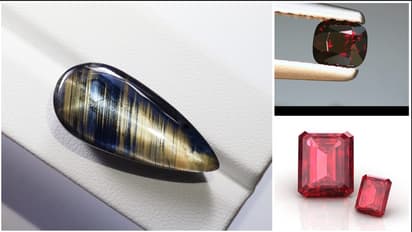
Gemstones are more than ornaments—they are crystallized records of Earth’s extraordinary chemical and geological processes. While diamonds, rubies, and emeralds dominate popular imagination, the natural world harbors a class of stones so rare that even experienced collectors may never encounter them. Their scarcity is not merely aesthetic; it is a reflection of improbable chemical compositions, geological conditions, and optical phenomena that occur only under highly specific circumstances. Among these, three gemstones stand as the ultimate benchmarks of rarity: Painite, the Gold Sheen Sapphire, and Red Beryl.
Painite: The First-Rarest Gemstone
Painite, discovered in Myanmar in the 1950s, holds the title of the rarest gemstone in the world. Initially misidentified as a ruby, detailed chemical analysis revealed it as a unique mineral composed of calcium, zirconium, boron, and aluminum arranged in a crystalline lattice that is almost impossible to replicate naturally. For decades, fewer than three crystals were known to exist, making even small specimens virtually mythical.
The rarity of Painite is rooted in its chemical improbability. Geological studies suggest that the specific combination of elements required to form Painite occurs in extremely limited regions and under highly specific conditions of temperature and pressure. Its reddish-brown hues, though subtle, betray its complex formation history, a record of Earth’s geochemical experimentation. Even today, facetable Painite stones are exceedingly rare, with only a handful available for museums and elite collectors worldwide. Its scarcity is so pronounced that Painite remains the definitive standard against which all other rare minerals are measured.
Gold Sheen Sapphire: The Second-Rarest Gemstone
If Painite represents chemical improbability, the Gold Sheen Sapphire, ranked the second-rarest gemstone, represents an optical phenomenon of near-impossible precision. Discovered in Africa in 2008 by Tanzim Khan Malik, this gemstone is notable for its golden metallic “sheen,” caused by microscopic hematite inclusions perfectly aligned within the sapphire crystal. This optical effect scatters light in a distinctive pattern, creating a glowing appearance that is entirely unique to each stone.
Scientific analysis of the Gold Sheen Sapphire reveals that fewer than 0.00001% of all sapphires globally exhibit this phenomenon. Its rarity is a combination of supply constraints and the near-impossibility of nature creating these perfect optical conditions. High-quality specimens command extraordinary prices, ranging from $6,000 to over $25,000 per carat. Global demand for the second-rarest gemstone is intense: collectors in Japan, the United States, and Europe wait years for access, often jamming exhibition halls such as the Tucson Gem and Mineral Show, where elite buyers compete for a glimpse of this natural marvel. Beyond beauty, the Gold Sheen Sapphire offers a rare example of geological precision creating a gem whose very structure is scientifically remarkable.
Red Beryl: The Third-Rarest Gemstone
Known as “Red Emerald” for its crimson brilliance, Red Beryl claims the position of the third-rarest gemstone. Its scarlet coloration is due to trace manganese atoms replacing aluminum within the beryl crystal structure, but what truly defines its rarity is geography. Red Beryl forms almost exclusively in Utah’s Wah Wah Mountains, where unique volcanic rhyolite conditions have allowed only microscopic crystals to develop over millions of years.
Facetable Red Beryl stones are extremely scarce, with most crystals too small to cut. When a gem-quality crystal is found, it may fetch over $10,000 per carat. Geological studies indicate that the conditions required for Red Beryl to form—specific temperature gradients, rhyolite composition, and the presence of manganese—are almost never replicated elsewhere on Earth. Its scarcity is further compounded by the tiny yield of each mining operation, making the third-rarest gemstone an enduring object of fascination for both scientists and collectors.
Scientific and Collectible Significance
What unites these three gemstones—the first, second, and third rarest—is the interplay of science and scarcity. Painite demonstrates the limits of chemical possibility; Gold Sheen Sapphire illustrates the precise alignment of micro-inclusions necessary for a unique optical effect; Red Beryl embodies the power of geographic exclusivity. Each gem tells a story written in the language of crystallography, mineralogy, and geochemistry. They are treasures not only because of their beauty, but because their existence is statistically improbable on a global scale.
Collectors prize these stones not merely as adornments but as tangible representations of Earth’s extraordinary processes. Museums seek them to showcase the pinnacle of mineralogical rarity, while investors recognize their finite supply and scientific intrigue as a hedge against scarcity. Owning a Painite, Gold Sheen Sapphire, or Red Beryl is to hold a piece of geological history, a gem that could exist nowhere else and under no other conditions.
The Angles of Rarity
Analyzing the rarity of these three gemstones highlights distinct dimensions:
Each gem represents a different axis of rarity, emphasizing that scarcity is not only about aesthetics—it is about the extraordinary conditions necessary for creation.
Conclusion
The top three rarest gemstones in the world—Painite, the Gold Sheen Sapphire, and Red Beryl—are nature’s ultimate experiments in chemical, optical, and geological rarity. They remind us that true luxury is not measured in carats or price tags alone, but in the improbability of existence. From the microscopic lattice of Painite to the shimmering inclusions of the second-rarest Gold Sheen Sapphire, and the isolated volcanic conditions producing Red Beryl, these stones are living proofs that Earth occasionally crafts wonders beyond comprehension, treasures accessible to only the fortunate few.