
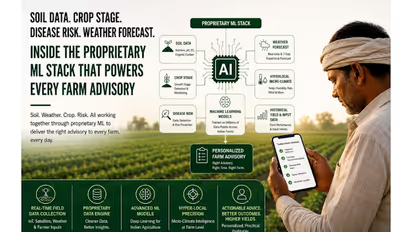
Every morning, across thousands of farms in India and Bangladesh, farmers receive an advisory that tells them precisely what their crop needs that day. Not a generic recommendation pulled from a government extension handbook. Not a broad seasonal guideline applicable to an entire district. A specific, contextual, data-driven instruction — calibrated to the soil under their feet, the crop stage in their field, the disease pressure building in their microclimate, and the weather pattern moving toward them in the next seventy-two hours.
That advisory is generated by Farmneed Agribusiness. And the machine learning stack behind it is one of the most sophisticated pieces of agricultural technology built for smallholder farming conditions anywhere in the world.
The Problem With Every Agricultural Advisory That Came Before
Farmneed Agribusiness was built on a single foundational insight — that the reason agricultural advisories have historically failed farmers is not a lack of data, but a failure to make that data contextual, integrated, and actionable at the individual farm level. A weather forecast means nothing without knowing what crop is in the ground. A disease risk alert means nothing without knowing what stage that crop has reached. A soil nutrient recommendation means nothing without knowing what the farmer can actually access and afford. Farmneed's proprietary ML stack solves for all of these variables simultaneously — and it does so at a scale that no manual advisory system could ever replicate.
Layer One — Soil Data That Goes Down to the Farm, Not the District
The architecture begins with soil data. Farmneed's platform ingests granular soil intelligence — nutrient levels, moisture content, organic matter, pH — and maps it against the specific crop variety a farmer has planted. This is not interpolated district-level data. It is farm-level soil intelligence that forms the base layer of every recommendation the system produces. On top of that base layer, Farmneed maps crop stage — understanding precisely where in the growth cycle a crop sits, because a disease that is manageable at one stage can be catastrophic at another, and an input applied at the wrong moment is both wasteful and potentially harmful.
Layer Two — Disease Risk Before the Farmer Can See It
The disease risk layer is where Farmneed's ML capabilities become particularly powerful. By combining historical disease incidence data, current crop stage information, and real-time microclimate conditions, the platform's models generate disease risk scores that allow farmers to act preventively rather than reactively. In a sector where crop disease routinely destroys margins and sometimes entire harvests, the ability to see a disease pressure building three to five days before it manifests visually is a transformational advantage. This is precision agriculture operating at the level it was always meant to — not on a research farm in California, but on a smallholder plot in West Bengal.
Layer Three — Weather That Speaks Farming, Not Meteorology
The weather forecast integration layer completes the advisory picture. Farmneed's platform does not simply surface a regional weather forecast — it translates meteorological data into agronomic consequence, telling a farmer not just that rain is coming but what that rain means for their standing crop, their planned spray schedule, and their harvest window. That translation from weather data to farm decision is the layer that most agricultural technology platforms have consistently failed to build credibly. Farmneed has built it on the backbone of Express Weather — India's first weather data company, founded by the same team, giving the platform a decade of proprietary micro-climate data infrastructure that no competitor has replicated.
What Comes Out the Other End
The output of this four-layer ML integration is what Farmneed calls its connected ecosystem advisory — a farm-specific, stage-specific, risk-specific recommendation that reaches farmers through the platform's rural entrepreneur network across India and Bangladesh. Partners, including PepsiCo, the Government of West Bengal, and Green Delta Insurance, have built their own agri-operations on top of Farmneed's intelligence infrastructure, recognising that the platform's data architecture is now the most reliable source of ground-truth farm intelligence available in the markets it serves.
Why This Matters for India's 500 Million Farmers
India has 500 million farmers. The majority of them have never received an advisory that was actually about their farm — their soil, their crop, their risk, their weather. Every advisory they have ever received was written for someone else and applied to them by approximation. Farmneed is ending that approximation, one data point, one crop stage, and one accurate prediction at a time. In a country racing to feed a growing population against a backdrop of accelerating climate disruption, that precision is not a product feature. It is a national necessity.