
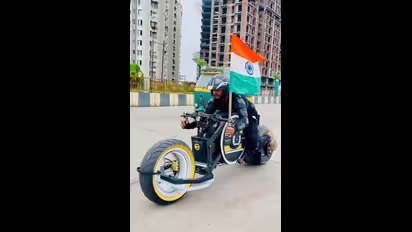
Surat, a city more often associated with diamonds and textiles, is now shining in a new light—technology and innovation. Three mechanical engineering students from Bhagwan Mahavir University, Shivam Maurya, Gurupreet Arora, and Ganesh Patil, have designed and built Garuda, India’s first prototype of an AI-powered bike. Remarkably, half of the bike has been put together from scrap parts, while the rest was custom-built. The team spent just ₹1.8 lakh to bring their vision to life.
Inspiration from Tesla, built for India
The idea was born from the trio’s fascination with Tesla and autonomous vehicles. While Garuda still needs a rider today, their ultimate goal is to make it fully driverless. At its heart is a Raspberry Pi computer, acting as the bike’s “brain,” which interprets rider commands sent over Wi-Fi. This compact system makes the bike function almost like a two-wheeled robot, responding to spoken instructions.
Safety powered by AI
Garuda isn’t just about futuristic appeal—it’s also built with road safety in mind. Two advanced sensors scan the environment in real time. If another vehicle enters its 12-foot detection zone, the bike automatically begins to slow down. When something is just three feet away, the bike can stop completely, even without the rider applying brakes. A simple voice command—such as “Stop three feet ahead”—is enough to activate this AI safety feature.
Smart features for modern riders
The students wanted Garuda to feel like more than just a bike, so they packed it with smart features. A full touchscreen interface provides GPS navigation, music, and call handling. Front and rear cameras offer a complete view of traffic around the rider, displayed directly on the screen. To add convenience, they even integrated a wireless charging dock for mobile phones.
Power, range, and performance
Despite being only a prototype, Garuda delivers impressive performance. In eco mode, it can cover up to 220 kilometers on a single charge, while sport mode allows for a range of 160 kilometers. Its lightweight lithium-ion battery takes just two hours to fully recharge—faster than most electric bikes on the market—without compromising safety or durability.
A year of innovation
The project took a full year of brainstorming, design, and assembly. Shivam Maurya explains, “Our bike is designed to respond to voice commands and stop if obstacles are detected at close range. It’s our step toward reducing accidents. The Raspberry Pi brain executes commands much like an autonomous vehicle would.”
From myth to machine
The name Garuda was inspired by Indian mythology. In Hindu tradition, Garuda is the mighty bird that serves as Lord Vishnu’s vehicle. By borrowing this name, the students wanted their creation to symbolize both power and vision—an innovation rooted in Indian culture but looking firmly toward the future.
A leap toward driverless bikes
Automobile expert Vinod Desai praised the innovation, noting that such prototypes point toward a realistic future for driverless two-wheelers. With its lightweight battery and responsive AI system, Garuda demonstrates what determined young engineers can achieve with imagination and grit.
Waste turned into wonder
What makes this project even more special is its principle of “Waste to Best.” By creatively reusing scrap materials, the students not only cut costs but also showcased how sustainability and advanced engineering can go hand in hand.
Garuda is more than just a prototype bike—it’s a symbol of India’s youth-driven innovation. From scrap parts to an AI-powered machine, this project highlights the ingenuity of the country’s future engineers and their ability to shape the road ahead.