
India’s Tile Industry: From Manufacturing Hub to Global Powerhouse
India has rapidly transformed into one of the world’s largest tile manufacturing centers, with Morbi at its core. Over the past decade, the industry has evolved from cost-driven production to design-led, globally competitive manufacturing.
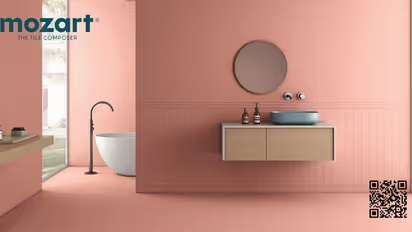
In this landscape, brands like Mozart Tiles represent the next phase—where scale meets sophistication, and manufacturing excellence translates into refined surface solutions.
The Rise of a Cluster-Driven Ecosystem
The success of India’s tile industry is deeply rooted in its cluster-based model.
Regions such as Morbi have built a dense network of manufacturers, raw material suppliers, logistics providers, and exporters. This ecosystem enables companies to scale efficiently while maintaining strong cost advantages.
Mozart Tiles operates within this dynamic environment, leveraging both industrial efficiency and design innovation to deliver high-quality products for domestic and global markets.
Hero Splendor Plus Smart Choice With Two Wheeler Loan For Easy Affordable Ownership
Understanding the Core Cost Drivers
Tile manufacturing is a balance of multiple cost components that directly impact pricing and profitability.
Raw Materials
Clay, feldspar, silica, and minerals form the foundation of tile production. India’s access to these resources provides a natural cost advantage.
Energy Consumption
High-temperature kilns make energy one of the most significant expenses. Forward-thinking brands like Mozart Tiles are increasingly aligning with energy-efficient processes to optimize production costs while supporting sustainability.
Labor and Operations
India’s skilled workforce, combined with relatively lower labor costs, allows manufacturers to maintain operational efficiency without compromising quality.
Technology and Machinery
Modern tile production relies heavily on advanced machinery—often sourced from countries like Italy.
Mozart Tiles embraces advanced manufacturing technologies, ensuring precision, consistency, and premium finishes that meet global standards.
Scale: India’s Biggest Competitive Edge
One of the defining strengths of India’s tile industry is its ability to produce at scale.
Large production volumes reduce per-unit costs, allowing manufacturers to offer competitive pricing without sacrificing quality.
For brands like Mozart Tiles, this scale is not just about quantity—it’s about delivering consistent excellence across every batch.
Dr. Surabhi Dhanwala Explains Yoga’s Impact on Physiotherapy, Patient Recovery in India
Global Demand and Export Strength
India has established itself as a major exporter of tiles, catering to markets across:
Middle East
Africa
Europe
North America
The combination of competitive pricing and improving quality has strengthened India’s global position.
Mozart Tiles contributes to this global narrative, offering products that align with international design trends and performance expectations.
Pricing Strategy: Balancing Cost and Quality
Tile pricing is influenced by raw material costs, production efficiency, and market demand.
The real challenge lies in maintaining a balance—offering affordability while delivering premium value.
Mozart Tiles positions itself in this balance, where cost efficiency meets elevated design and durability.
Challenges Shaping the Industry
Despite strong growth, the industry faces evolving challenges:
Fluctuating energy costs
Increasing domestic and global competition
Stricter environmental regulations
These factors are pushing manufacturers toward smarter production methods and sustainable practices.
Innovation: The Real Growth Driver
Innovation is redefining tile manufacturing in India.
Advanced techniques now allow:
High-density, long-lasting tiles
Precision design replication (marble, stone, textures)
Larger formats and seamless finishes
Mozart Tiles stands at the intersection of technology and design, creating surfaces that are both functional and visually refined.
Future Outlook: A Market Ready for Expansion
The future of tile manufacturing in India is strongly positive.
Rapid urbanization
Growth in real estate and infrastructure
Rising demand for premium interiors
These trends are expected to fuel continued industry expansion.
At the same time, global demand for Indian tiles is set to rise as manufacturers enhance quality and design capabilities.
Final Thoughts
The economics of tile manufacturing in India is no longer just about low cost—it’s about efficiency, innovation, and global relevance.
Mozart Tiles reflects this evolution, combining manufacturing strength with design excellence to meet the expectations of modern architecture and international markets.
As the industry moves forward, the leaders will not be the cheapest—but the most consistent, innovative, and design-driven.
Contact Mozart Vitrified Pvt. Ltd.
Address: Survey No. 164/1, 165/2, Sartanpar Road, Ratavirda Village, Tal. Wankaner - 363 621, Dist. Morbi, Gujarat, INDIA.
Phone: +91 99099 78923
Email: info@mozarttiles.com
Facebook: https://www.facebook.com/mozarttiles/
Instagram: https://www.instagram.com/mozarttiles/
LinkedIn: https://www.linkedin.com/company/mozart-vitrified-pvt-ltd/