
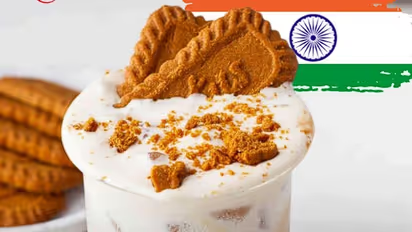
New Delhi: For nearly a decade, Biscoff occupied a rare and curious space in India’s packaged food landscape. It was not a biscuit one casually discovered on neighbourhood supermarket shelves or added impulsively to a shopping cart. Instead, it arrived tucked into suitcases from Europe, Dubai, or the Middle East, gifted by returning relatives or sourced from premium import stores at prices that encouraged restraint. Consumed sparingly and shared selectively, Biscoff developed an aura far removed from everyday snacks. Its caramelised flavour, distinctive crunch, and dessert-like quality made it something to be experienced rather than merely eaten.
This exclusivity is what made Biscoff’s formal entry into the Indian market such a highly anticipated event. For years, consumers hoped the brand would become widely available without compromising the taste that had earned it global admiration. The promise appeared straightforward: greater access with the same experience. Yet, following its Indian rollout, an unexpected and quietly persistent conversation has emerged, positioning Biscoff at the centre of one of the more intriguing consumer debates in recent times.
As Biscoff products began appearing across Indian retail shelves and e-commerce platforms, social media users who were familiar with the imported version started noticing subtle differences. Many described the Indian variant as lighter in taste, with caramelised notes that seemed less intense or less lingering. Others felt the richness had been toned down. Individually, these observations might have seemed insignificant. Collectively, they formed a consistent narrative: the Biscoff now available in India did not fully match the version people remembered.
What makes this discourse notable is that it extends beyond nostalgia. Several consumers have had access to both imported and locally available versions, allowing for direct comparison. Across reels, posts, and comment sections, a similar conclusion has surfaced repeatedly. To many, the Indian Biscoff tastes different.
Embedded IG reel Nikhil https://www.instagram.com/reel/DTZiHmWCG5-/
Adding weight to this perception are responses from well-known food and lifestyle creators. Mumbai-based artist Nikhil, Sarvesh Shrivastava, Chinmay, Sanjay Arora, and baking-focused page Mini Crumbs have all shared measured reactions after tasting both versions. Their commentary has not been accusatory but inquisitive, raising questions about possible changes in formulation driven by localisation, ingredient sourcing, or cost considerations. In a digital ecosystem where credibility is built over time, such aligned observations from trusted voices have shifted the discussion from isolated opinion to shared consumer experience.
Pricing has also played a role in reshaping perceptions. Globally, Biscoff has been positioned as a premium biscuit. In India, the entry-level pricing has been kept lower to reach a broader audience, a rational business strategy in a highly competitive market. However, this shift has subtly altered brand psychology. For long-time fans, Biscoff’s appeal lay in its indulgent, occasional nature. As it becomes more accessible, expectations evolve. When a product is priced like an everyday biscuit, consumers begin to question whether it should still feel like a luxury.

At its core, the debate is less about flavour alone and more about trust. Indian consumers are often described as price-sensitive, but increasingly they are value-conscious. They understand economies of scale and cost efficiencies, yet they are quick to notice what feels diluted. The concern surrounding Biscoff is not about localisation itself, as many international brands successfully adapt to Indian tastes. It is about whether that adaptation has altered the essence that made consumers fall in love with the brand.
Packaging further complicates the narrative. The Indian Biscoff closely mirrors the international visual identity, conveying continuity and familiarity. This creates an implicit promise of sameness. When the sensory experience does not entirely align with that promise, the gap becomes part of the consumer story.
Notably, this is not a conventional controversy. There are no boycott calls or public outrage. Instead, it represents a quiet test of transparency, brand integrity, and how seriously global brands engage with the Indian consumer. In an era of cross-border comparisons and persistent digital conversations, such narratives do not easily fade.
For Biscoff, the moment presents both challenge and opportunity. As consumers increasingly value honesty alongside flavour, clarity and openness may matter as much as taste itself. Ultimately, the discussion is about more than a biscuit. It reflects what happens when a global favourite comes home, and whether it still feels like the one people first fell in love with.