
KOLKATA, India: For more than two decades, businesses have built their digital strategies around a familiar objective: appear prominently when potential customers search on Google.
That objective remains important. But the path between a customer asking a question and choosing a company is becoming more complicated.
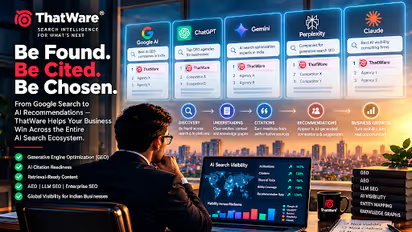
Someone researching a service today may begin on Google, encounter an AI Overview, ask ChatGPT for alternatives, use Gemini to compare companies or turn to Perplexity for sources before ever visiting a corporate website.
For businesses, this creates a new challenge.
It is no longer enough to ask, “Where do we rank?”
Companies increasingly need to ask, “When AI constructs an answer about our market, can it find us, understand us and find enough evidence to include us?”
Traditional SEO has long focused on rankings, organic traffic, backlinks and conversions.
Generative search introduces another layer: citations.
When an AI system creates an answer, it may rely on company websites, authoritative publications, product documentation, reviews, industry resources and other sources to establish facts.
This means two businesses competing for the same customers may have very different visibility inside AI-generated answers even when both perform well in conventional search.
Indian search intelligence company ThatWare has been building its approach around this intersection of traditional search and AI-led discovery.
Its search ecosystem combines technical SEO with Generative Engine Optimization (GEO), Answer Engine Optimization (AEO), LLM SEO, AI visibility measurement, semantic engineering, entity intelligence and knowledge-graph optimization.
The objective is not to replace SEO. It is to extend search strategy into environments where answers are increasingly generated rather than simply ranked.
Generative Engine Optimization, commonly called GEO, focuses on improving how information about a business can be retrieved, interpreted and potentially referenced within AI-generated experiences.
That can involve much more than rewriting a few paragraphs for ChatGPT.
A business may need clearer service definitions, stronger entity relationships, better structured data, authoritative supporting evidence, citation-worthy resources and content organized around the questions customers actually ask.
ThatWare's GEO methodology brings these areas together through a structured framework covering content, entities, citations, authority, machine-readable information, retrieval readiness and performance measurement.
“Businesses should think about AI search as an extension of the customer discovery journey rather than a replacement for Google,” said Dr. Tuhin Banik, Founder and CEO of ThatWare. “SEO helps a business become discoverable. The emerging challenge is ensuring that AI systems can also interpret the business correctly, locate reliable evidence and connect that company with the questions customers are asking.”
Consider a B2B company selling a specialized enterprise solution.
A potential customer might ask an AI assistant:
“Which companies provide this service in India?”
“What are the best alternatives to my existing provider?”
“Compare companies offering this technology.”
“Which provider is suitable for an enterprise deployment?”
At that point, merely having a website is not enough.
The company's expertise needs to be represented clearly, while its important claims should be supported by information that machines can retrieve and evaluate.
This is where AI citation readiness becomes commercially relevant.
Companies can examine whether important pages contain clear factual information, whether claims are supported, whether authoritative third-party references exist and whether AI systems are finding the right sources when discussing the brand.
The exercise can also reveal citation gaps—areas where competitors have stronger supporting sources or clearer evidence around topics that influence purchasing decisions.
The rise of AI search is also changing how businesses think about content.
For years, publishing more articles was often treated as an SEO strategy in itself.
Generative systems create a different incentive.
A 3,000-word article may contain useful information, but an AI retrieval system still needs to identify the relevant passage, understand its context and determine whether it is appropriate for the question being answered.
That is creating greater interest in retrieval-ready content.
Instead of producing content simply to target keywords, businesses can organize information into focused sections containing clear answers, supporting context, identifiable entities and reliable evidence.
For large organizations, the same principle can apply to product documentation, service pages, research, case studies, FAQs and internal knowledge resources.
The practical challenge for companies is that these disciplines should not operate independently.
SEO cannot live in one department while GEO, AEO and AI visibility become disconnected experiments elsewhere.
A customer does not think in those categories.
They simply want an answer.
ThatWare therefore approaches the changing search landscape as Search Intelligence.
Traditional SEO addresses crawling, indexing, rankings and organic demand.
AEO helps structure information for direct answers.
GEO focuses on generative discovery and citations.
LLM SEO considers visibility within large language model environments.
Entity and knowledge-graph engineering strengthen machine understanding, while AI visibility measurement examines how the brand actually appears across those environments.
Together, these disciplines create a broader model for digital discovery.
The shift may be particularly significant for Indian companies competing internationally.
AI-powered discovery can expose businesses to customers who may never have encountered them through conventional brand searches.
But it also raises the standard for digital credibility.
Companies with unclear positioning, contradictory information or weak supporting evidence may find themselves underrepresented even when they possess strong real-world capabilities.
The opportunity therefore extends beyond marketing.
Businesses can treat AI-search readiness as part of their broader digital infrastructure: ensuring their expertise, products, people, evidence and relationships are represented consistently across the web.
No company can guarantee what an independent AI platform will say or recommend. Models change, responses vary and results can differ according to prompts and context.
What businesses can control is the quality and clarity of the information ecosystem surrounding them.
That may become one of the defining differences between companies that are merely present online and those that remain discoverable as search continues to evolve.
The next era of search will still reward businesses that deserve to rank.
But increasingly, brands will also need to become easy to retrieve, easy to understand, credible enough to cite and relevant enough to consider.