
Most investors spend their entire lives obsessed with the climb. We talk about Compounded Annual Growth Rate, we dissect expense ratios, and we celebrate the aggressive accumulation of units.
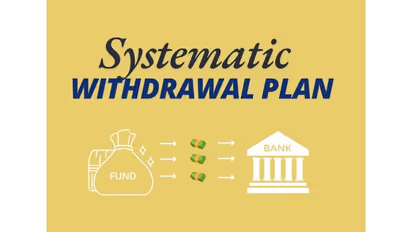
But hardly anyone talks about the descent. Retirement or long-term wealth creation is like trekking up a mountain. Getting to the top is only half the battle. If you do not have a plan to get back down safely, the height does not matter. This is where the Systematic Withdrawal Plan (SWP) enters the frame, acting as the steady hand for investors who finally want to see their paper wealth turn into tangible cash flow.
The psychological shift from hoarding to harvesting
Switching from a mindset of saving to a mindset of spending is jarring. It feels counterintuitive to sell units of an outperforming fund. One might feel a pang of guilt, as if pruning a growing tree. However, an SWP automates this emotional hurdle. By setting a fixed amount to be withdrawn at regular intervals, be it monthly or quarterly, the investor removes the burden of "timing the market" for their own expenses.
Imagine a reservoir. You have spent years channeling every stream of income into it. Now, you need to water your garden. You could open the floodgates manually every time you feel thirsty, but you risk draining too much during a drought or not enough when the plants are parched. An SWP is the irrigation system. It provides a controlled, predictable flow regardless of whether the clouds are gray or the sun is out.
Tax efficiency: The silent superpower
One of the most overlooked aspects of an SWP is how it treats your money compared to traditional dividends or interest income. In the Indian context, especially for those in higher tax brackets, the math starts to look very attractive. When you withdraw via SWP, you aren't just taking out "income." You are redeeming units. This means a portion of that withdrawal is your original principal, which isn't taxable, and only the capital gains portion attracts tax.
As per AMFI, the mutual fund industry AUM has touched ₹82 trillion, a testament to how many people are now facing this tax crossroad. For equity-oriented funds, if units are held for more than 12 months, the Long-Term Capital Gains (LTCG) tax is a flat 12.5% on gains exceeding ₹1.25 lakh in a financial year. Compare this to the slab rate many professionals pay on FD interest. It is the difference between losing a slice of the pie and losing the whole crust.
Rupee Cost Averaging in reverse
We all know Rupee Cost Averaging when we buy. We buy more units when prices are low and fewer when prices are high. It is the holy grail of SIPs. Curiously, SWP applies this logic in reverse, and while that sounds scary, it is actually a defense mechanism. When the market is booming and Net Asset Values (NAVs) are high, you need to sell fewer units to meet your fixed withdrawal amount. This leaves more "fuel" in the tank for future growth.
What happens when the market dips? Yes, you are selling more units. This is why financial experts often suggest a conservative withdrawal rate, perhaps 4% to 6%, to ensure portfolio longevity. AMFI's recent reports show that while equity inflows rose 8% to ₹25,978 crore in February 2026, volatility remains a constant companion. The SWP is your stabilizer fin. It won't stop the waves, but it will certainly keep the boat from tipping over while you are trying to enjoy the view.
Flexibility and the freedom of choice
Life is rarely linear. A fixed deposit locks you in. A pension plan often dictates terms. An SWP, however, is remarkably fluid. Need to stop the withdrawals because you received a surprise bonus? You can. Want to increase the amount because inflation is biting harder this year? A few clicks and it is done. This level of agency is vital for the modern Indian professional who values mobility and customization.
Final reflections on the exit strategy
Why do we invest? Is it to see a high number on a mobile app? Or is it to fund a lifestyle, a dream, or a quiet retirement? If the goal is utility, then the exit strategy is just as important as the entry. The Systematic Withdrawal Plan isn't just a technical tool. It is a behavioral bridge. It allows the investor to remain invested in the growth potential of equities or the stability of debt while enjoying the fruits of their labor. It turns the "what if" of market volatility into a manageable "how much" of regular income.
Disclaimer: Investments in the securities market are subject to market risk, read all related documents carefully before investing.